Native Tapioca Starch
About This Product
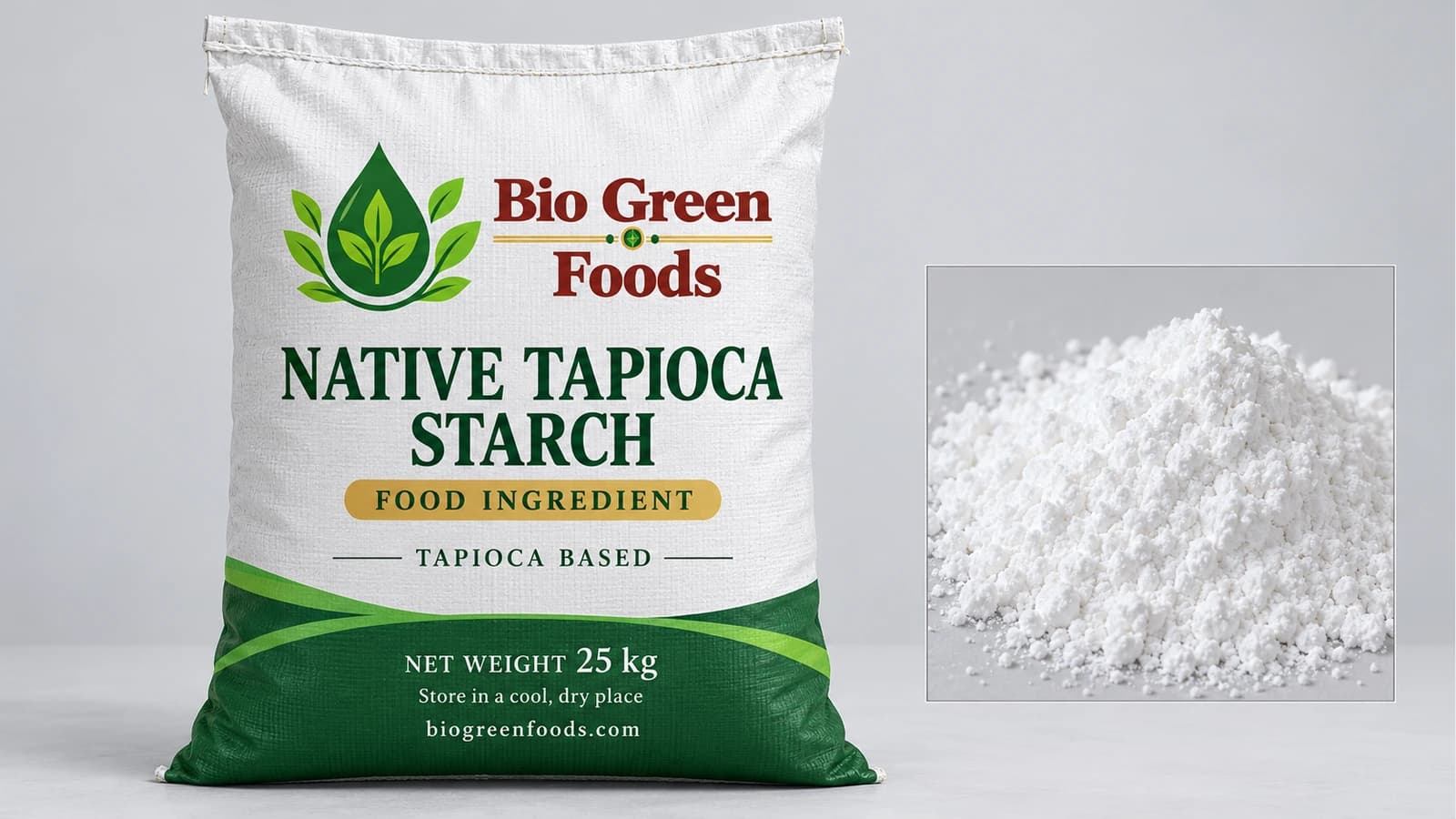
Native tapioca starch is the starch washed, extracted and dried from the root of the cassava plant, Manihot esculenta, with no chemical or physical modification. It is a fine white powder of roughly 17 per cent amylose and 83 per cent amylopectin, which is what separates it in use from the cereal starches.
That composition has three consequences a formulator can rely on. It gelatinises at a lower temperature than maize starch, broadly in the high fifties to the high sixties rather than the low sixties to low seventies in Celsius, so it thickens earlier in a cook and costs less energy to bring to full viscosity. It swells further before the granule ruptures, so peak viscosity is high and the starch goes a long way on a weight basis. And because tapioca carries almost no lipid and almost no protein, the cooked paste is clear and the flavour is genuinely neutral, where maize starch leaves both a haze and a cereal note that has to be covered.
The trade-off is that the paste is long and cohesive rather than short, and that an unmodified starch has none of the process tolerance a modified grade is bought for. It thins under prolonged shear, it thins in acid, and it will not survive retorting or a freeze-thaw cycle without syneresis. Where any of those conditions apply, a cross-linked or stabilised grade is the correct choice and native starch is false economy.
It is used as a thickener and texturiser in soups, sauces and gravies, as a binder and water-holding aid in sausage and other comminuted meat, as a crumb softener and volume aid in bakery, in the noodle and rice-product trade for bite and elasticity, and as the feedstock for glucose syrup, maltodextrin and the modified starches themselves. It is naturally gluten free and, as cassava is not grown from engineered seed on any commercial scale, non-GM.
Bio Green Foods supplies native tapioca starch of Southeast Asian origin as a fine white food-grade powder in 25 kg bags and jumbo bags. Grade limits for moisture, ash, pH, whiteness, residual sulphur dioxide and peak viscosity are confirmed on the agreed specification and on the batch certificate of analysis.
Specifications
Applications
Packaging Options
- 25 kg bag
- Jumbo bag
Indicative price: $0.45–1.40/kg
Indicative bulk guide only. Prices are market-linked and updated regularly - please request a quote for current pricing and volume rates.


Start with the recipe and the market
- Finished food, target function and process conditions
- Required grade, physical form and critical limits
- Destination market and permitted-use requirements
- Quantity, packaging and delivery destination
Confirm the evidence before ordering
Food-grade identity alone does not establish permission for every food or country. Confirm permitted use, limits and labelling requirements for the intended market. Certification availability must be checked for the nominated product and manufacturing site.
Product illustrations show representative material and packaging. The quotation confirms the actual source, grade, pack size and labelling.
Review documentation