Distilled Monoglyceride (E471)
About This Product
Distilled monoglyceride, DMG, is the purified form of the E471 emulsifier mono- and diglycerides of fatty acids. It is supplied as white flakes, beads or powder, and is a lipophilic non-ionic surfactant with an HLB of roughly 3.6 to 4.2.
The difference between this and ordinary glycerol monostearate is concentration, and it changes how the material behaves. Direct glycerolysis gives a mixture that is typically 40 to 60 percent monoester, the rest being di- and triglycerides and free glycerol that contribute little emulsification. Molecular distillation strips that away to leave 90 percent or more monoglyceride. Only the monoester has both a free hydroxyl head and a fatty tail, so only the monoester does the work: it is the fraction that complexes with amylose to slow starch retrogradation, that stabilises the alpha-crystalline fat phase in a cake batter, and that controls fat agglomeration in an ice cream mix. Using the distilled grade therefore lets a formulator dose a third to a half as much for the same effect, with less carry-over of neutral fat into the recipe and more consistent behaviour from batch to batch. The practical catch is dispersion: at 90 percent monoester the material is more crystalline and needs hydrating as a gel or melting into the fat phase rather than being tipped into a dough dry.
It is used as a crumb softener and anti-staling agent in bread and cake, as an aerating emulsifier in cake batters and whipped toppings, in ice cream for fat destabilisation and dryness, in margarine and spreads, and in chewing gum base and starch products.
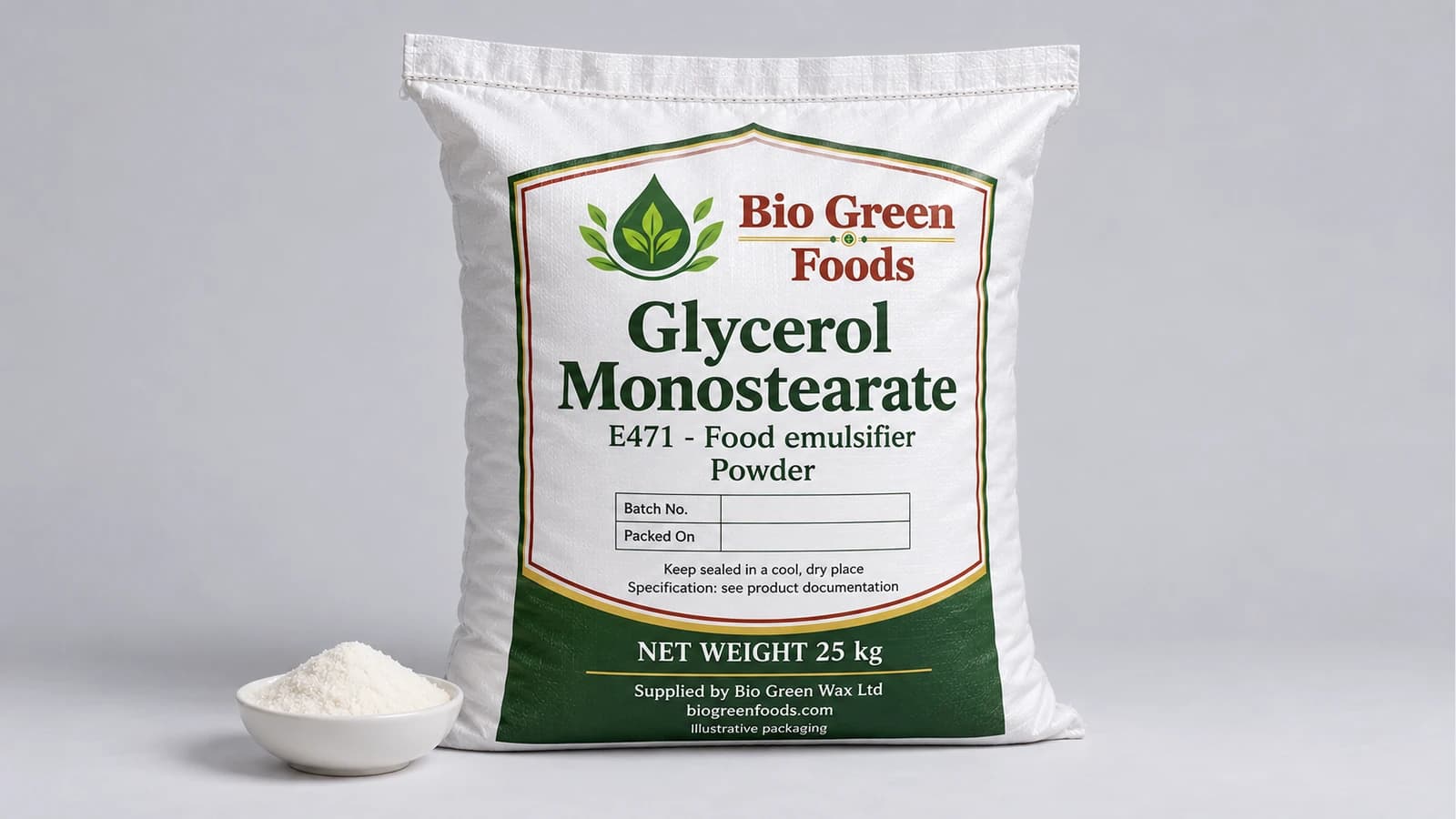
Bio Green Foods supplies distilled monoglyceride at 90 percent minimum monoester to specification on monoglyceride content, free glycerol, iodine value, melting point and acid value, in 25 kg bags as flakes, beads or powder.
Specifications
Applications
Packaging Options
- 25 kg bag
Indicative price: $1.00–6.00/kg
Indicative bulk guide only. Prices are market-linked and updated regularly - please request a quote for current pricing and volume rates.
Start with the recipe and the market
- Finished food, target function and process conditions
- Required grade, physical form and critical limits
- Destination market and permitted-use requirements
- Quantity, packaging and delivery destination
Confirm the evidence before ordering
Food-grade identity alone does not establish permission for every food or country. Confirm permitted use, limits and labelling requirements for the intended market. Certification availability must be checked for the nominated product and manufacturing site.
Product illustrations show representative material and packaging. The quotation confirms the actual source, grade, pack size and labelling.
Review documentation