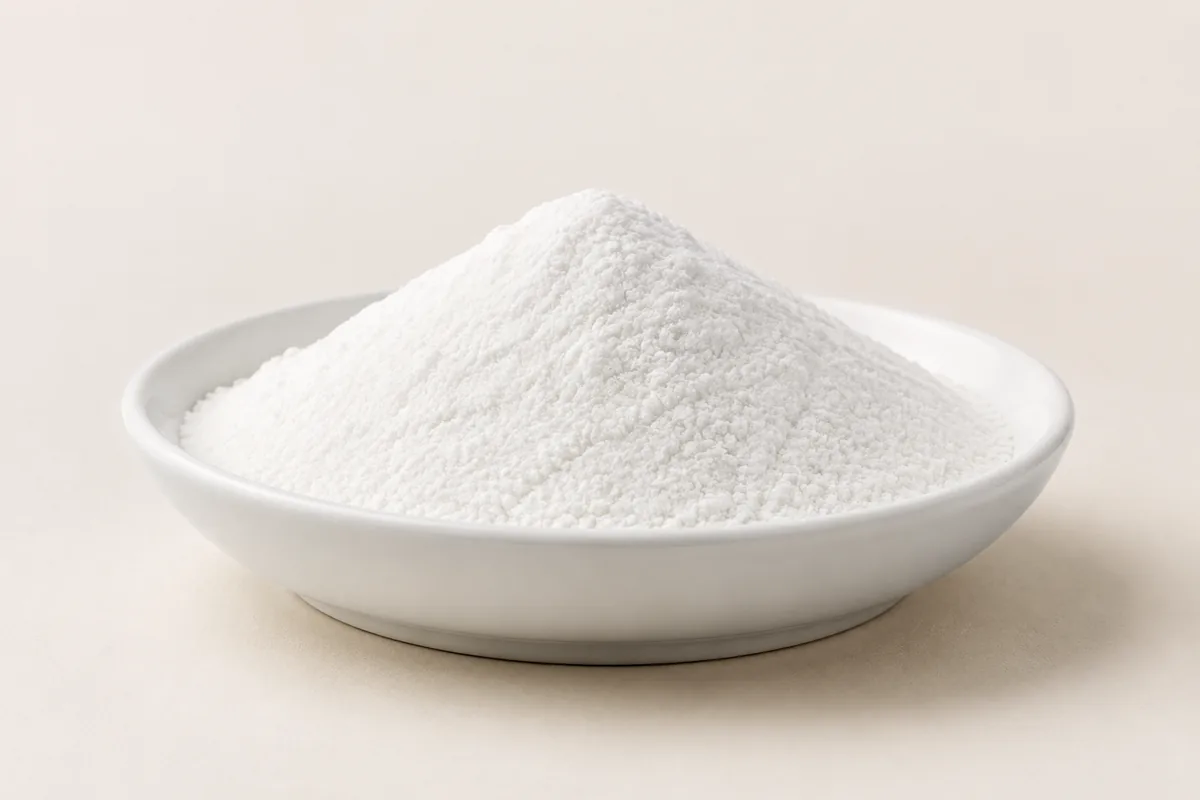
Maltodextrin is one of the most versatile ingredients in food manufacturing. It is a carrier, a bulking agent, a source of body and a readily digestible carbohydrate. It is bought mainly by its dextrose equivalent (DE), and that one number predicts much of how it will behave. This guide explains what DE means, how the common grades differ, and when to move up to glucose syrup or dextrose.
What DE measures
Maltodextrin is made by partially hydrolysing starch with enzymes, acid or both, then purifying and spray-drying the result. Dextrose equivalent is the reducing-sugar content of the product, expressed as dextrose and as a percentage of dry solids. Native starch has a DE close to zero and pure dextrose has a DE of about 100. The further hydrolysis goes, the shorter the saccharide chains and the higher the DE.
By definition, maltodextrin has a DE below 20. Products at DE 20 and above are glucose syrups or, when dried, dried glucose syrup (also called glucose syrup solids). DE is an average: two products with the same DE can have different saccharide profiles depending on the enzyme and process used, and that can change viscosity and hygroscopicity. If your application is sensitive, ask for the saccharide distribution as well as the DE.
Maltodextrin is a food ingredient, not a food additive, so it has no E-number. It can be made from maize, potato, tapioca, wheat and other starches, and the botanical source affects labelling, allergen status and GMO documentation.
How properties change as DE rises
- Sweetness increases, although even DE 20 is far less sweet than sucrose.
- Solubility and dissolving speed increase.
- Hygroscopicity increases, so powders cake and become sticky more easily.
- Viscosity, body and film-forming ability decrease.
- Browning through the Maillard reaction increases.
- Freezing-point depression and osmolality increase.
- The glass transition temperature falls, which makes powders stickier during spray drying and storage.
Comparison: DE 10–12 vs DE 15–20 vs higher (indicative)
- DE 10–12: very low sweetness, higher viscosity, the best film-former and encapsulant, and the lowest hygroscopicity and browning. Used as a spray-drying carrier for flavours and oils, for body in soups, sauces and dairy desserts, as a partial fat replacer, and in sports drinks where low osmolality matters.
- DE 15–20: slight sweetness, faster dissolving and lower viscosity. Used in instant beverage powders, dry mixes, fruit powder carriers, confectionery and bakery glazes, and as a filler in tablets and sachets.
- Higher DE: dried glucose syrups of DE 20–40 and above, liquid glucose syrups, and dextrose at about DE 100. These are sweeter, brown more readily and act as stronger humectants and crystallisation controllers. They are used in confectionery, bakery, beverages and fermentation. See glucose syrup and dextrose.
Typical specification parameters
- DE range, for example 9–12, 15–18 or 18–20, with the test method stated
- Moisture, typically 6% maximum
- pH of a 10% solution, commonly in the range of about 4 to 6
- Bulk density and particle size, and whether the grade is agglomerated for instant dispersion
- Appearance, colour and odour of the powder and of a solution
- Sulphated ash, residual sulphur dioxide and heavy metals
- Microbiological limits, such as total plate count, yeasts and moulds, coliforms and absence of Salmonella
- Botanical source, GMO status and allergen statement
See our maltodextrin page for grade and packing details.
Choosing the right grade
Spray drying. A lower DE raises the glass transition temperature of the dried powder, which reduces stickiness in the dryer and caking in the pack. High-sugar juices and honey are hard to dry without a substantial proportion of low-DE maltodextrin.
Beverage and dry mixes. DE 15–20 dissolves faster and adds mild sweetness, but it is more hygroscopic, so use moisture-barrier packaging in humid markets.
Sports and clinical-style nutrition. For the same weight, lower-DE grades have fewer, larger molecules and therefore lower osmolality than higher-DE grades or dextrose, which matters in carbohydrate drinks. Our nutrition and supplements hub covers carriers alongside minerals and vitamins.
Shelf-stable products. Higher-DE solids lower water activity more than the same weight of low-DE maltodextrin, because they contribute more molecules. Water activity is one of the hurdles that determine how much preservative a product needs, as our food preservatives and acidulants guide explains.
Labelling points
- Maltodextrin is declared by name in the ingredients list.
- In the nutrition declaration it counts as carbohydrate, and its mono- and disaccharide content counts towards sugars. The higher the DE, the larger that share.
- Wheat-based maltodextrins are exempt from the cereal-containing-gluten allergen declaration under Annex II of Regulation (EU) No 1169/2011 and its UK retained equivalent. If you make a gluten-free claim, ask for gluten test data.
- For maize-derived grades, ask for GMO status and supporting documentation.
Storage and handling
Store bags sealed in a cool, dry place and rotate stock, because maltodextrin picks up moisture and cakes, and higher-DE grades do so faster. Fine carbohydrate powders are combustible dusts, so assess dust-explosion risk in tipping, conveying and blending areas and keep equipment earthed. If you need halal, kosher or food-safety certification, request the certificate scope with your quotation and check that it covers the manufacturing site and product.
Frequently asked questions
What is the most common maltodextrin grade?
Grades around DE 10–12 and DE 15–20 are the most widely traded. The best choice depends on whether you need body and film formation (lower DE) or faster dissolving and mild sweetness (higher DE).
Is maltodextrin a sugar?
Not in the everyday sense, but it is a carbohydrate, and the mono- and disaccharides it contains count as sugars on the nutrition declaration. Higher-DE grades contribute more.
Can I swap DE 10 for DE 18?
Often, but expect more sweetness, lower viscosity, faster browning and a stickier, more hygroscopic powder. Retest the texture, the drying performance and the shelf life.
Does maltodextrin need an E-number on the label?
No. It is a food ingredient rather than an additive, so it is declared by name.
Is maltodextrin gluten-free?
It depends on the source and the data. Maize, potato and tapioca maltodextrins contain no gluten sources. Wheat-based maltodextrins are exempt from allergen labelling, but a gluten-free claim still needs supporting test results.