Shelf life is rarely down to one ingredient. It comes from a set of hurdles working together: pH, water activity, heat treatment, packaging, chilled storage and, where they are needed, preservatives. Acidulants and preservatives are closely linked, because acidulants lower pH, and low pH is what makes the most common food preservatives effective. This guide explains how to choose both, gives indicative starting dosages, and sets out the compliance points to check in the EU and UK. It is general guidance, not a substitute for challenge testing and a regulatory review of your own product.
How weak-acid preservatives work
Most widely used food preservatives, including benzoic, sorbic, propionic and acetic acids and their salts, are weak acids. Their antimicrobial activity comes mainly from the undissociated acid, which passes through the microbial cell membrane and disrupts the cell from within. The proportion of acid that stays undissociated depends on the gap between the product's pH and the acid's pKa. At a pH equal to the pKa, half the acid is undissociated. One pH unit above the pKa, only about 9% is. One unit below, about 91% is.
Approximate pKa values are 4.2 for benzoic acid, 4.8 for sorbic acid, 4.9 for propionic acid and 4.8 for acetic acid. This is why pH is the first selection criterion: a preservative that works well in a pH 3 soft drink may do very little in a pH 6 bakery filling.
Choosing a preservative (indicative)
- Benzoates (E210–E213): most effective below about pH 4.5, and ideally at pH 4.0 or lower. Mainly active against yeasts and moulds. Typical uses are soft drinks, fruit-based drinks, sauces and pickles. Sodium benzoate (E211) is the most common form, and potassium benzoate (E212) is used where sodium reduction matters.
- Sorbates (E200, E202): effective up to about pH 6, which gives them a wider working range than benzoates. Active against moulds and yeasts and some bacteria. Typical uses are cheese, bakery fillings, dips, dressings, drinks and dried fruit. Potassium sorbate (E202) is the soluble salt form.
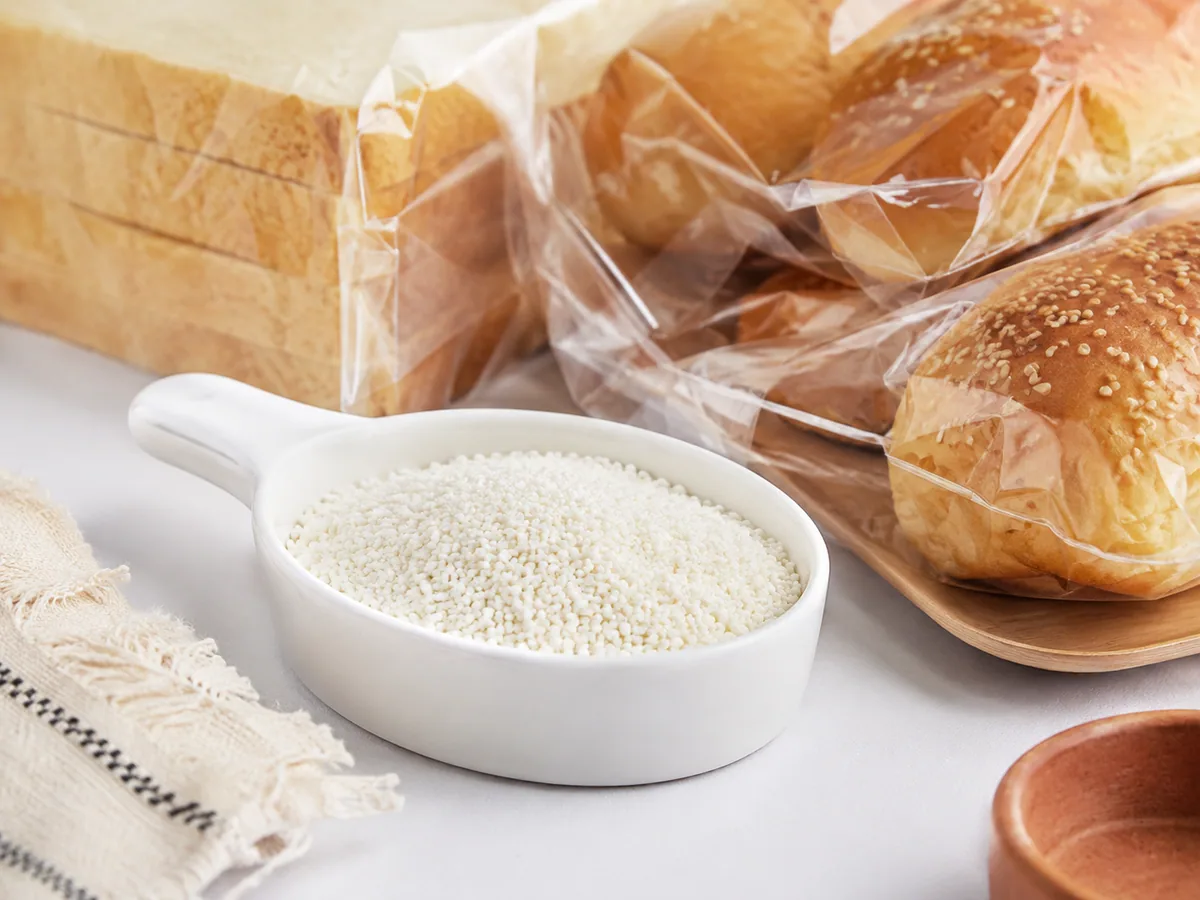
- Propionates (E280–E283): effective up to about pH 5.5–6 against moulds and rope-forming Bacillus, with little effect on baker's yeast, which makes them the standard choice for bread. Calcium propionate (E282) and sodium propionate (E281) are the usual forms.
- Sulphur dioxide and sulphites (E220–E228): antimicrobial, and also antioxidant and anti-browning. Typical uses include wine, dried fruit, some meat products and crustaceans. Sodium metabisulfite (E223) is a common source.
- Acetic acid and acetates (E260–E263): acetic acid, potassium, sodium and calcium acetates contribute acidity and preservation in pickles, sauces, bakery and cooked meats.
- Nitrites (E249–E250): used in cured meats for safety and colour, and tightly regulated in both permitted levels and use.
Indicative starting dosages
The figures below are common development starting points, not legal limits. The permitted maximum for your food category is often the binding constraint, and it is set in the annex referred to in the compliance section.
- Calcium propionate in bread: commonly around 0.1–0.3% of flour weight, adjusted for loaf type, packaging and target shelf life. Higher levels can slow fermentation and affect flavour.
- Benzoates and sorbates: use levels across food categories typically run from a few hundred to around two thousand mg/kg, and drinks usually sit at the lower end. Check the category maximum before trialling.
- Citric acid and other acidulants: dosed to reach the target pH and taste rather than a fixed level.
- Sulphites: dosed to achieve a target free or total SO2 level, with allergen labelling required above the threshold described below.
EU and UK maximum levels for these preservatives are expressed as the free acid (for benzoates and sorbates), as propionic acid (for propionates) or as SO2 (for sulphites), not as the salt you add. These theoretical conversion factors come from molar masses. Use the assay on your certificate of analysis for exact work.
- 1 kg sodium benzoate provides about 0.847 kg benzoic acid.
- 1 kg potassium benzoate (anhydrous) provides about 0.762 kg benzoic acid.
- 1 kg potassium sorbate provides about 0.746 kg sorbic acid.
- 1 kg calcium propionate (anhydrous) provides about 0.795 kg propionic acid.
- 1 kg sodium propionate provides about 0.771 kg propionic acid.
- 1 kg sodium metabisulfite provides at most about 0.674 kg SO2.
Acidulants: choosing by taste, pH and function
- Citric acid (E330): clean, sharp and fruity. It is the most widely used food acid, and it also chelates metal ions, which supports antioxidants. See citric acid, and our explainer on citric acid anhydrous vs monohydrate for choosing a form.
- Malic acid (E296): a smoother, more lingering sourness that blends well with intense sweeteners.
- Lactic acid (E270): mild and slightly dairy-like, used in dairy-style products, meat and bakery.
- Acetic acid (E260) and vinegar: a pungent sourness, standard in pickles, sauces and dressings.
- Phosphoric acid (E338): a sharp, flat sourness, best known from cola drinks.
- Tartaric acid (E334): a hard, grape-like sourness, also used in baking powders.
Buffer salts such as sodium citrate (E331) and sodium acetate (E262) moderate sourness and hold pH steady over shelf life, and sodium citrate also stabilises proteins in dairy and plant-based drinks.
Designing the preservation system
- Measure pH in the finished, equilibrated product, not in the ingredients or the sauce base. Particulates, proteins and fermentation can shift pH over shelf life.
- Lower water activity reduces the preservative you need. Sugars, salt and polyols all lower water activity, and so do concentrated recipes.
- Mind interactions. Benzoate combined with ascorbic acid can form trace benzene under heat and light, especially with metal ions present, so control formulation, packaging and storage. Sorbates inhibit baker's yeast, so use propionates in yeast-raised dough and keep sorbate to fillings, toppings or surface treatments. Calcium ions interfere with chemical leavening, so cakes and batters use sodium propionate rather than calcium propionate. Sulphites destroy thiamine (vitamin B1).
- Validate. Confirm shelf life with challenge testing or predictive modelling, especially for chilled ready-to-eat foods where Listeria monocytogenes is a concern.
Our bakery ingredients hub covers propionates and leavening systems in more detail, and our comparison of sodium benzoate vs potassium sorbate goes deeper into the two most common preservatives.
Compliance essentials in the EU and UK
Authorisation. The food additives permitted in the EU, the food categories they may be used in and their maximum levels are set in Annex II of Regulation (EC) No 1333/2008. Great Britain applies the retained version of that regulation, and Northern Ireland continues to follow the EU rules. Limits differ widely between categories, many preservatives share combined group limits, and the annex is amended regularly, so always check the current consolidated text for your exact category rather than relying on a recipe from another product or market.
Purity. Additives must meet the specifications in Regulation (EU) No 231/2012 or its GB retained equivalent. Ask your supplier to confirm that the grade conforms to the specification for the relevant E-number, and for other markets to the applicable standard, such as the Food Chemicals Codex or JECFA specifications.
Labelling. Under Regulation (EU) No 1169/2011 and its UK retained equivalent, additives are declared by functional class followed by their specific name or E-number, for example "preservative: sodium benzoate" or "preservative: E211". Sulphur dioxide and sulphites at concentrations above 10 mg/kg or 10 mg/litre, expressed as SO2, must be emphasised as an allergen.
Export markets. Other markets maintain their own additive lists and limits, so check each destination separately.
Documents. For each preservative and acidulant, request the specification, a certificate of analysis for the batch, the safety data sheet, and allergen and GMO statements. If you need halal, kosher or food-safety management certification, request the certificate scope with your quotation and check that it covers the manufacturing site and product.
A practical selection workflow
- Define the product, its pH, water activity, process, packaging, target shelf life and storage conditions.
- Identify the likely spoilage organisms and any pathogens of concern.
- Shortlist preservatives by pH and target organism, and acidulants by taste and pH target.
- Check the category and maximum level in the current Annex II, and convert your dose to the basis the limit uses.
- Trial at two or three levels, with sensory evaluation and challenge testing.
- Fix the specification and approve the supplier with complete documents before scaling up.
Frequently asked questions
Which preservative works at neutral pH?
Weak-acid preservatives lose most of their effect near neutral pH. Sorbates are the most tolerant, working up to about pH 6. Near-neutral foods rely more on heat treatment, chilling, reduced water activity and packaging, and on other antimicrobials that are permitted only in specific categories.
Is citric acid a preservative?
It is authorised as an acid, acidity regulator and antioxidant rather than as a preservative. It supports preservation indirectly by lowering pH, which makes weak-acid preservatives more effective.
Can benzoates and sorbates be used together?
Yes. Blends are common in drinks and sauces, but many food categories set a combined maximum for sorbates and benzoates, so check the current annex for yours.
How much calcium propionate should I use in bread?
Indicatively around 0.1–0.3% of flour weight, adjusted to your loaf, packaging and shelf-life target, and always within the legal maximum for the category.
Do preservatives have to be declared on the label?
Yes. They are listed in the ingredients by functional class with their name or E-number, and sulphites above the threshold must also be emphasised as an allergen.