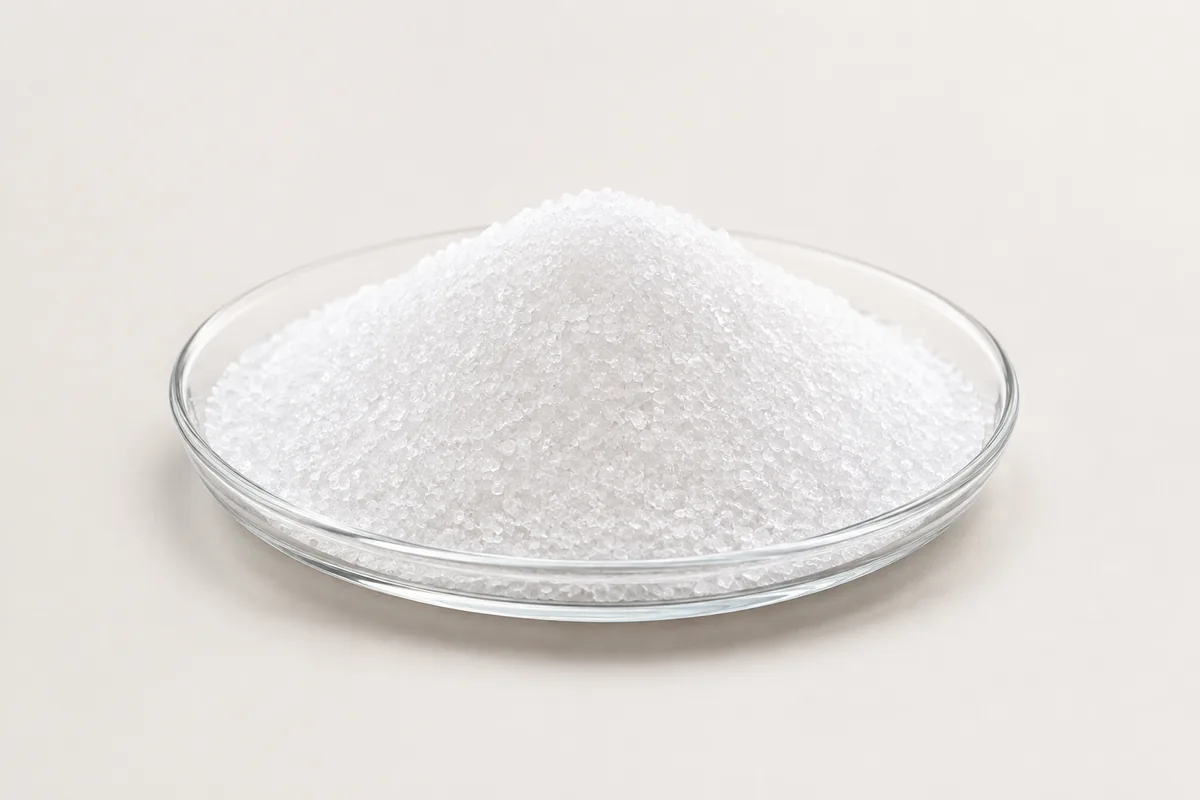
Citric acid is the most widely used acidulant in food and drink, and it is sold in two crystalline forms: anhydrous and monohydrate. Both are E330, both are the same acid, and both perform identically once dissolved. The differences are water content, weight-for-weight strength and behaviour in storage and dry mixes. Choosing the right form, and converting correctly when you switch, avoids off-target acidity and caking problems.
Same acid, different water content
Anhydrous citric acid has the formula C6H8O7, a molar mass of 192.12 g/mol and the CAS number 77-92-9. Citric acid monohydrate carries one molecule of water of crystallisation, giving C6H8O7·H2O, a molar mass of 210.14 g/mol and the CAS number 5949-29-1. The water accounts for about 8.6% of the monohydrate's weight.
Which form a plant produces depends on crystallisation temperature. Citric acid crystallises from water as the monohydrate below about 36.6 °C and as the anhydrous form above it. Most commercial citric acid is produced by fermentation of carbohydrate, followed by purification and crystallisation. Both forms are covered by the E330 purity criteria in Regulation (EU) No 231/2012 and its GB retained equivalent, and by the major pharmacopoeias and the Food Chemicals Codex.
Converting between the forms
Because the monohydrate contains water, you need more of it to deliver the same amount of acid:
- 1.000 kg anhydrous equals about 1.094 kg monohydrate.
- 1.000 kg monohydrate equals about 0.914 kg anhydrous.
For example, a recipe using 2.0 kg of anhydrous citric acid per batch needs about 2.19 kg of monohydrate. Titratable acidity in beverages is usually reported as anhydrous citric acid, so keep your specifications and calculations on the same basis. If you switch forms without converting, the product will be about 9% more or less acidic than intended.
Comparison: anhydrous vs monohydrate (indicative)
- Water content: anhydrous typically 0.5% maximum; monohydrate typically 7.5–9.0%.
- Assay: both typically 99.5–100.5%, usually calculated on the anhydrous basis.
- Storage behaviour: anhydrous absorbs moisture in humid conditions but is otherwise stable; monohydrate can lose water of crystallisation when stored warm or in dry air, and the released moisture promotes caking.
- Best suited to: anhydrous for dry mixes, powdered drinks, effervescent tablets, confectionery sanding and other low-moisture products; monohydrate for liquid applications such as soft drinks, syrups, sauces and cleaning products, where the extra water does not matter.
- Particle sizes: both are available as granular, fine granular and powder grades, often described by mesh range, for example 8–40, 30–100 or finer (indicative).
Which form should you buy?
- If the acid is dissolved into a liquid, either form works. Decide on availability, handling and price on an anhydrous-equivalent basis.
- If it goes into a dry blend or a low-moisture product, choose anhydrous. The monohydrate's water can migrate into the blend, react with carbonates or bicarbonates, and cause caking or premature fizzing.
- For effervescent tablets and powders, use anhydrous with a low moisture specification, and control humidity during blending and packing.
- For sour sanding on confectionery, use fine granular anhydrous acid, sometimes blended with other acids, and pack the product in moisture-barrier packaging.
See our citric acid product page for grade and packing details, and our beverages and confectionery hubs for how citric acid fits into complete formulations.
Buffering with sodium citrate
Citric acid on its own can taste harsh, and pH can drift during storage. Sodium citrate (E331), usually supplied as trisodium citrate dihydrate, buffers the acid, softens its sharpness and holds pH steady. In soft drinks, the ratio of citric acid to sodium citrate sets both pH and perceived sourness. In gelatine and pectin confectionery, sodium citrate protects the gel from acid damage during depositing.
Specification points to agree
- Form (anhydrous or monohydrate) and assay, with the calculation basis
- Water content
- Particle-size distribution, or the mesh range
- Sulphated ash, sulphate, oxalate and heavy metals such as lead
- Readily carbonisable substances, and the clarity and colour of solution
- Conformity with E330 and, where needed, with a pharmacopoeia or the Food Chemicals Codex
- Allergen and GMO statements, including any statement on the fermentation substrate, plus origin information
If you need halal, kosher or food-safety certification, request the certificate scope with your quotation and check that it covers the manufacturing site and product.
Storage and handling
Store both forms in sealed bags in a cool, dry place, away from sources of heat and humidity, and use stock in rotation. Avoid temperature cycling, which drives caking, particularly with monohydrate. Citric acid dust irritates the eyes, so use eye protection and dust control when tipping bags. Keep it away from carbonates and bicarbonates in storage, and remember that concentrated citric acid solutions attack some metals, so check the materials used in dissolving tanks and dosing lines.
Citric acid is authorised in a wide range of food categories, in many cases at quantum satis, but not in every category. Check Annex II of Regulation (EC) No 1333/2008 and the UK retained equivalent for your product. For wider context on acidulants and preservation systems, see our guide to food preservatives and acidulants.
Frequently asked questions
Is citric acid monohydrate weaker than anhydrous?
Per kilogram it contains about 8.6% less citric acid, because part of its weight is water. Once dissolved, the acid is identical.
Can I replace monohydrate with anhydrous one for one?
No. Use about 0.914 kg of anhydrous for every 1 kg of monohydrate, or 1.094 kg of monohydrate for every 1 kg of anhydrous.
Why does my citric acid cake in storage?
Usually because of humidity or temperature cycling. Monohydrate can release water of crystallisation when warm, and both forms absorb moisture in humid air. Keep bags sealed and storage conditions stable.
Is citric acid natural?
Citric acid occurs naturally in citrus fruits, but commercial citric acid is produced by fermentation. For claims about its origin, check the wording rules in your market and the supplier's statements.
Which form is better for effervescent tablets?
Anhydrous, with a low moisture specification. Water from the monohydrate would start the reaction with the carbonate or bicarbonate before the tablet is used.